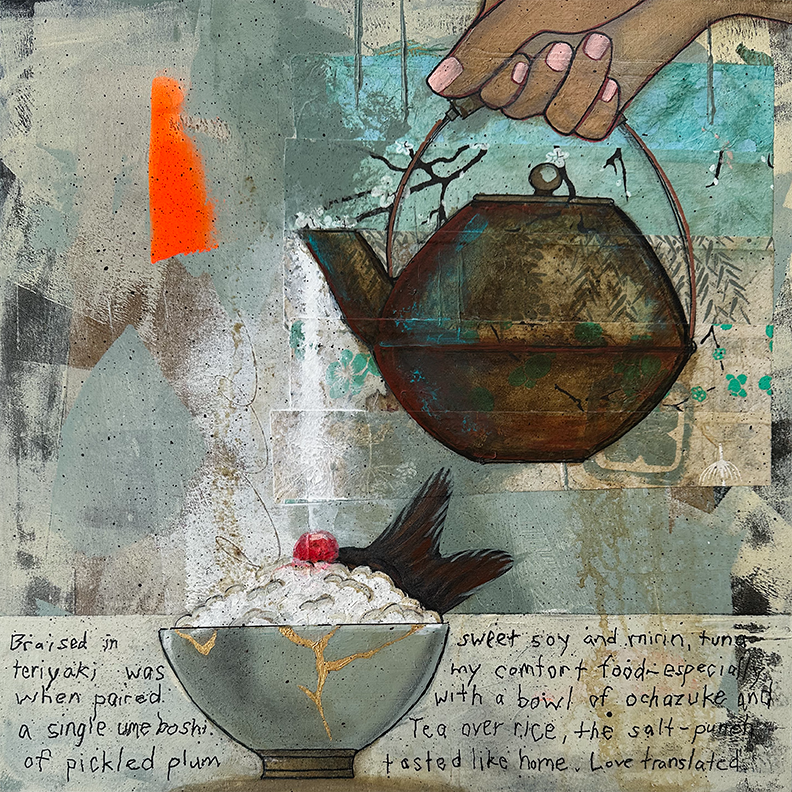
Making Culture: From Ochazuke to Adobo
San Francisco in the 1960s carried the scent of immigrant kitchens—fish sauce and garlic, sweet bread cooling in panaderías, tortillas blistering on stovetop flames, soy and ginger rising from Chinatown alleys. My childhood unfolded in these layers. By age three, my parents had divorced, and a fire had taken our Western Addition apartment. My mother, my siblings, and I were sent to Ping Yuen, the Chinatown housing project everyone called “The Ping.”
The Ping was its own world. Thin walls, thick air, overlapping languages—Cantonese, Tagalog, Spanish, and all kinds of English. Hallways carried dumplings, adobo, tamales and steamed rice. Kitchens worked late into the night: knives chopping, pots clattering. Poverty shaped us, but so did this shared labor of survival. Some days lunch was a mayonnaise sandwich. On good days, it was onigiri packed with katsuobushi. I remember opening a new box of shaved bonito flakes and finding a tiny wooden kokeshi doll tucked inside—my own Cracker Jack prize. Nobody else seems to recall those dolls, but I do.
Our meals reflected scarcity and resourcefulness: Spam, hot dogs, tofu, the occasional chicken or pork, cheap vegetables—cabbage, celery, carrots. We made do. And in making do, we made culture.
My mother’s cooking was a map of where we came from and who we were becoming. Chicken karaage, crisp and juicy, still lives in my kitchen. Sukiyaki appeared on special occasions, tempura with sweet potato, yaki salmon salted just right. At my father’s house, the flavors shifted: Filipino adobo, stews thick with vinegar and garlic, always followed by Catholic Mass.
At my mother’s, a small butsudan anchored our spiritual life. Ancestor photos leaned against a wooden frame; bowls of rice and incense smoke rose each evening. My life moved between spiritual and cultural homes: Catholic hymns and Buddhist chants. Fish sauce and soy sauce. Adobo and ochazuke.
In the 1970s, I was bused from Chinatown to the Mission District as part of desegregation. My world expanded. At lunch, I traded bites with classmates: tamales wrapped in corn husks, pupusas filled with cheese, pan dulce dusted with sugar. After school, my best friend Rosa toasted tortillas directly over the flame, spread them with butter and salt, and handed one to me before we played outside. The Mission taught me that cultures didn’t cancel each other out—they sat side by side on the same plate.
Racism still found me. At ten, in Chinatown, an SFPD officer called me a racial slur. I froze, already carrying stories of police violence. The fear settled into my body before I had language for it.
I didn’t want to be Japanese. I wanted to be loud, American, safe—with burgers and fries instead of bento. And yet my deepest comfort came from meals unmistakably Japanese. My mother sliced thick slabs of maguro for sashimi. I hated it raw and refused to eat it. She never argued. She braised mine in soy and mirin until it became tuna teriyaki, glossy and tender, soaking into the rice beneath. That meal was mine alone—her way of saying, I see you.
Often, she paired it with ochazuke: steaming rice sprinkled with toasted bits, hot tea poured over, a single umeboshi anchoring the center. The first bite always startled me—the crunch against soft rice, the sour plum cutting through the warmth. It wasn’t for guests or celebration. It was for home, for healing. Food that told me I belonged.
Even when I tried to hide the parts of myself that marked me as different, food remembered when I tried not to.
Now I live in Oakland. Japanese culture is everywhere—supermarket sushi, Michelin-star ramen, anime conventions, boba on every corner. What I once tried to shrink from is now celebrated. Ochazuke even appears on fusion menus. The food of my childhood has shifted from alienation into pride.
Still, nothing compares to my mother’s hands preparing it: the steam rising, the umeboshi nestled in the rice. In that moment, past and present collide. Fear and hope share the same bowl. Survival continues quietly, carried in the food and the stories.
Food carried me through shame, transformation, and reclamation. It keeps my mother alive though she is gone, connects me to ancestors I never met but honor at my altar, and gives me language when English fails.
In immigrant kitchens, in the humble meals of my childhood, I see survival. I see resilience. I see belonging.
And I remember.